

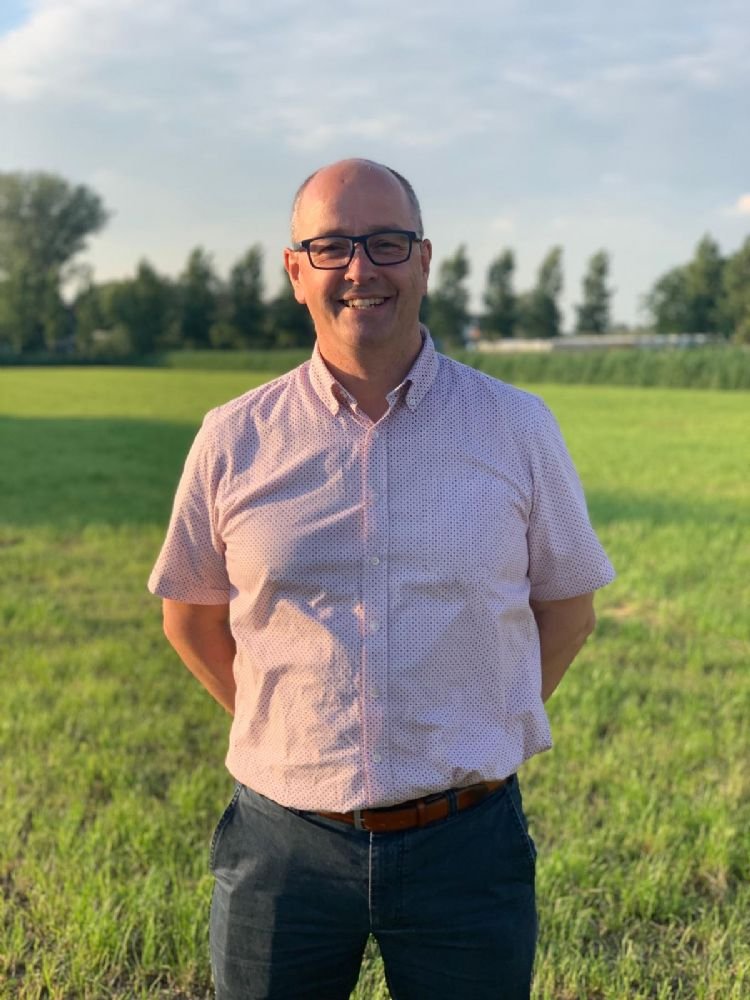
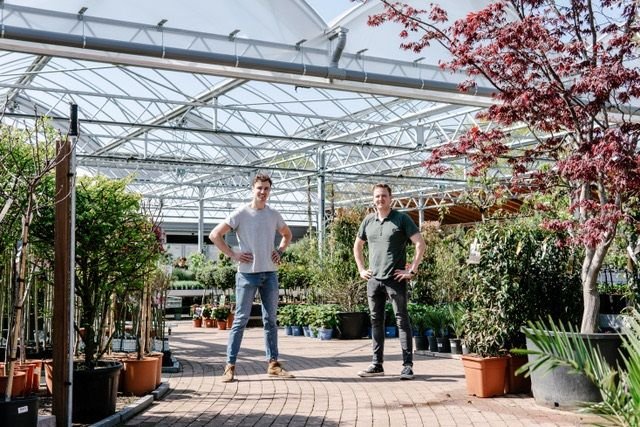
Rovero is enjoying great success with its Roll-Air polytunnel. This revolutionary greenhouse is typically used in nurseries, but the system has now been installed for the first time in a garden center in the Netherlands. Intratuin Barneveld is the first to do so. Jan van Hemert (Rovero) and Ton Uljee (Intratuin Barneveld) give us an extensive look inside the new greenhouse.
Intratuin Barneveld has the scoop. Jan van Hemert (Rovero) and Ton Uljee (Intratuin Barneveld) give us an extensive look inside the new greenhouse. Rovero , a specialist in polytunnels and tunnels, has built a Roll-Air polytunnel at Intratuin Barneveld to partially cover the outdoor area. It's the first in the Netherlands. "A Roll-Air greenhouse for a garden center is quite unique in our country. In neighboring countries, especially England, Ireland, and the Scandinavian countries, convertible greenhouses are already much more common. Why only now here? I think Dutch garden centers are more attracted to glass greenhouses—which are often very beautiful, by the way. You create a certain atmosphere with the Roll-Air greenhouse; it feels like you're shopping outdoors. You close it in bad weather. You create a sense of experience; that was also the approach of Intratuin Barneveld." We hope this will become a trend in the Netherlands,' says Jan van Hemert.
Ton Uljee (property owner/advisor at Intratuin Barneveld) adds: "Many garden centers opt for a fixed greenhouse with multiple rows of ventilation, or an open-sky greenhouse. But in my experience, those are still buildings you stand inside. With so many hard materials and technology surrounding you, there's more of an indoor atmosphere. We believe: outside is outside, and it should truly feel like "outside." There are those convertible greenhouses where the ridges open outwards. This Roll-Air greenhouse is even more fragile, even lighter, even more beautiful—even more "outside," and that's exactly what we wanted."
England
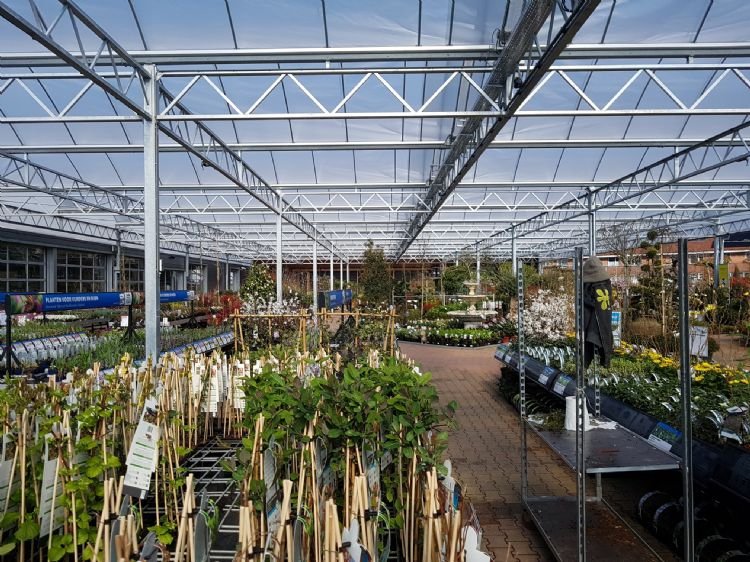
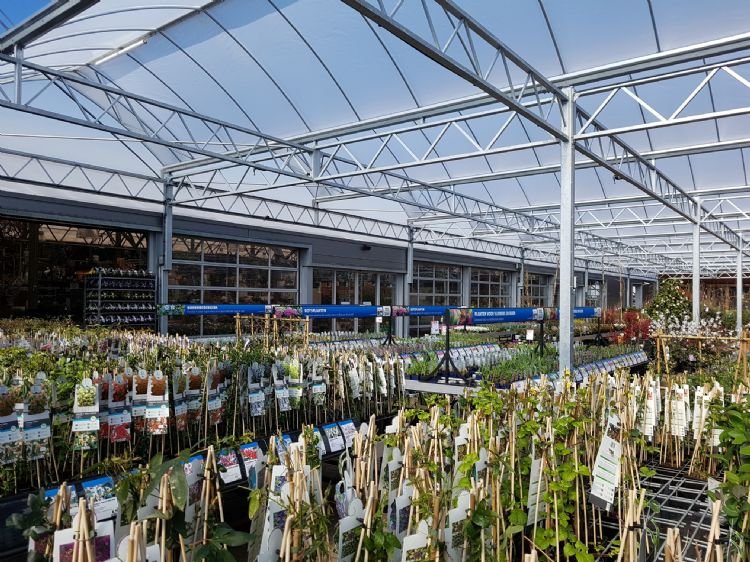
The idea for the convertible greenhouse originated in England, where this concept has long been common in garden centers. Van Hemert explains: "Intratuin Barneveld contacted us, and that's how the ball started rolling. This greenhouse differs from the standard greenhouses we usually build for tree nurseries. The 9.60-meter roof width is common. However, the bay length is different, being 9.00 meters instead of 4.50 meters. We did this to minimize the number of columns in the canopy. This creates a more open atmosphere and reduces obstacles, also in relation to the store layout and walkways."
According to Van Hemert, different requirements apply to a garden center greenhouse than to a grower's production greenhouse. "The requirements are stricter; that's because there are shoppers there. But we already had experience with that, especially abroad."
Before the green light for the Roll-Air greenhouse was given in December 2019, there was a period of consultation and design adjustments. "Clients also have their own ideas about the design; so we regularly sparred with them. Everything also had to be technically feasible. It truly became a custom project." During this process, an architect was also hired, Theo de Git of Breddels Architects. "He supervised the project and discussed the technical aspects with us, as did Ton Uljee, not to mention. For example, we had to add a greenhouse facade to the existing facade of the garden center, which meant we had to make some adjustments. We built the entire greenhouse with our own subcontractor."
Uljee looks back on the project's completion with great pleasure. "Initially, the plan was to dedicate part of the cold greenhouse to the entrance and add an escalator for carts. This would have meant losing a lot of space in the cold greenhouse and requiring the construction of a large covered outdoor section. Ultimately, however, that plan fell through, and we opted to build a larger outdoor section, but with the Roll-Air system. Now we have more than half of the outdoor section covered."
Uljee continues: "The tender was quite short-notice, but all credit goes to the team that built it. I've never seen a team build so modestly, disciplined, and quickly. That was fantastic. It was a bit of a nail-biter, as it had to be finished by the beginning of March. A shop had to be ready for the season. And we managed that. We had a fantastic few weeks in the new section, but then the coronavirus crisis hit."
“ Due to the open atmosphere, the shop layout and the walkways, there are few columns in the roof. ”
Open character
Van Hemert highlights the major advantages of the Roll-Air greenhouse: "It's an open-close system. You can roll the greenhouse completely open, bringing the outdoor climate indoors. A production greenhouse is primarily used for growing plants and trees and then for hardening them off after opening; with a greenhouse in a garden center, you create ambiance. You can quickly open and close the roof, adapting to weather conditions. The facades can also be closed or opened, but Intratuin has chosen to leave three open. The open character is the most important for the garden center. Furthermore, the greenhouse is useful during the Christmas season; customers can admire the Christmas trees, which are normally kept outside, indoors if necessary."
"I keep talking about the outdoors; you might wonder why we built that greenhouse in the first place." Uljee wants to highlight three factors that played a major role. "Firstly, there's night frost. It's a nightmare when you have delicate plants outside that are ten to twelve times more likely to be damaged in the spring. Hauling everything inside every time is incredibly labor-intensive, and it doesn't do the plants any good. Secondly, wind and rain can throw a wrench in the works later in the season. Customers don't come when it rains. Thirdly, we have our Christmas tree sales outside. When it's very cold or snowing, that's almost impossible for our employees and customers. Or think about last year, when it almost always rained."
Van Hemert continues: "We said to each other: we have to do something about that. When the greenhouse is open, you're completely outside, but if necessary, you can easily shut out the elements with a Roll-Air greenhouse. Along the way, we discovered something else. The greenhouse is oriented exactly north-south, and the roofs run east-west, so that half of each roof faces exactly south. When it's very sunny and warm, the south side of the greenhouse can be closed, creating shade. In the summer, for example, you can make sure the hydrangeas aren't in direct sunlight. And in the winter and early spring, you can close the roof and enjoy the sunshine and a pleasant temperature."
" With the sprinkler system, you can irrigate precisely without wind. You can also let natural rain do its work by opening the roof. "
Precise irrigation
The Roll-Air greenhouse, as mentioned, also has aesthetic qualities. "Although the space is open, the height does somewhat diminish it. The materials inside also appear larger." A sprinkler system has also been installed, allowing for very precise irrigation without wind. Furthermore, you can, of course, let natural rain do its work by opening the roof. "That's better than cold groundwater," says Uljee.
The new greenhouse connects to the "warm" section of our center, as we call it, which we keep frost-free. A space has been built against it that largely blocks out the elements. This reduces heat loss during the winter months and also keeps the climate in the existing permanent greenhouse more pleasant.
Uljee notes that customers greatly appreciate the experience in the new greenhouse. "With this beautiful spring weather, you can just walk outside and shop." He expects to enjoy the greenhouse for a long time to come. "And when the plastic wrap wears out in a few years, we'll put new plastic on." Intratuin Barneveld wants to give customers the feeling of being close to nature.
Van Hemert expects this project in Barneveld will definitely be replicated. "Several garden centers are already interested in seeing it, and we've even received a request for a similar greenhouse from another garden center."
The polytunnel at Intratuin is 57.60 meters wide (six bays of 9.60 meters each) and 27.00 meters long (three bays of 9.00 meters each). By also using trusses under the gutters, larger bays can be created, requiring fewer columns. The gutter height is 4.50 meters. One facade has ventilation, one facade is built against the existing building, and the other facades remain open.